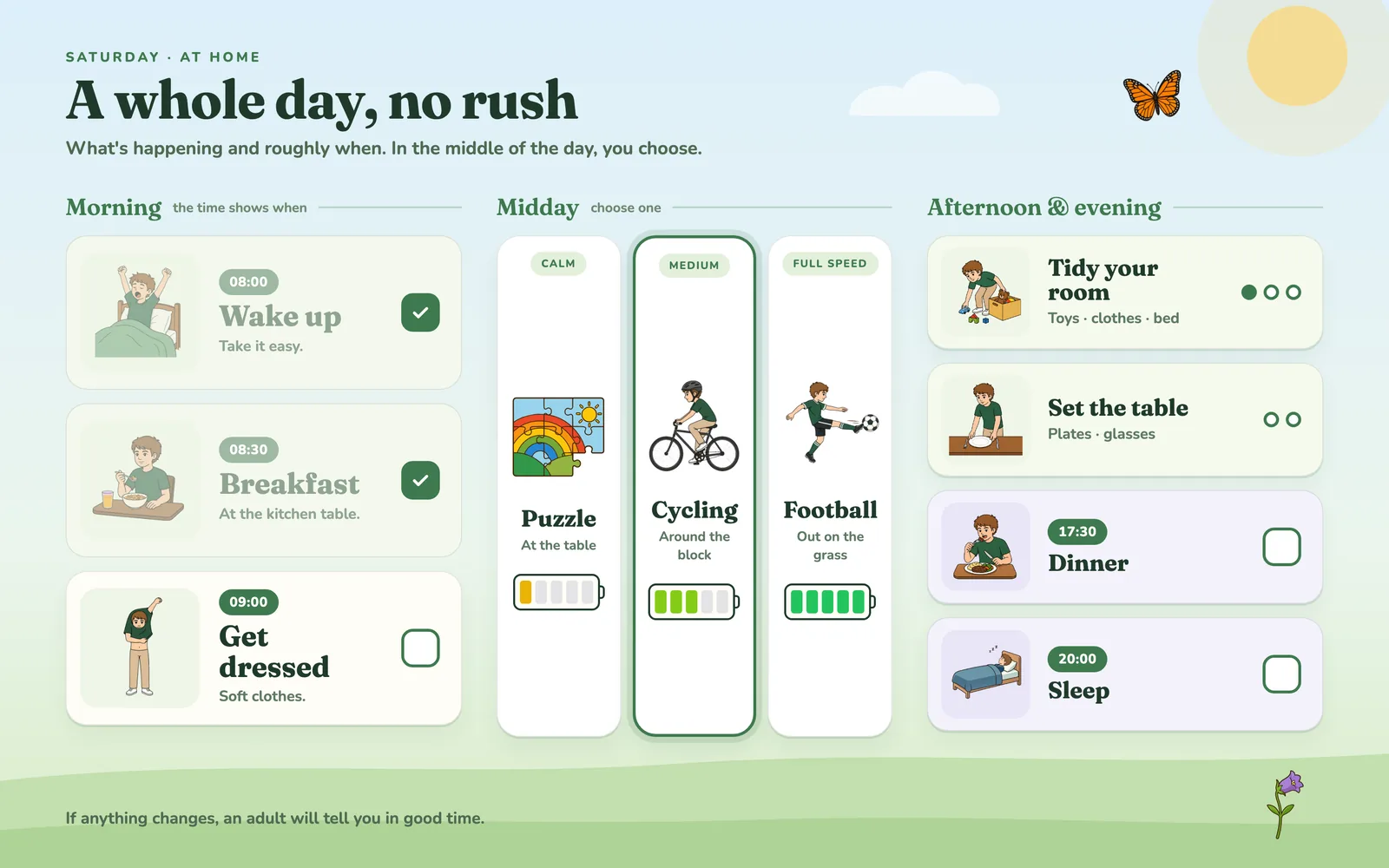
Visual supports with AI means you describe what you need and get a draft back, instead of hunting for pictures and pasting them together yourself. That saves time. But the AI does not know the child, and a visual support only helps if it fits the child’s everyday life.
This article looks at what is known about visual supports, what AI can and cannot do, how it works in practice, and what to check before the visual support goes up.
What are AI visual supports?
There are two kinds of tools, and the difference matters.
General image tools, like ChatGPT, draw a new picture from what you write. You can get almost anything, but every picture is drawn anew, so the same thing rarely looks the same twice. How to do it and where it falls short is covered in ChatGPT for visual schedules.
Tools built for visual supports let the AI pick and arrange symbols from a fixed library. Then the toothbrush looks the same in the morning routine as in the evening routine. That is how Áigi Plan works: the AI draws no new pictures for the schedule, it builds it from the library’s symbols. Your own photo can become a symbol in the same style as the rest.
Why visual supports work, however they are made
AI is one way to make the visual support. It is the visual support that makes the difference, so it is worth knowing what is known about it.
SPSM, the Swedish National Agency for Special Needs Education and Schools, describes how pictures stay, unlike speech, which disappears as soon as it is said. According to SPSM, visual support can take load off working memory, increase the child’s independence and reduce stress and worry (SPSM, 2026a). In its guidance on ADHD, SPSM writes that working with visual support “can take load off working memory and promote attention” (SPSM, 2026b). More on that in ADHD and visual supports.
In autism, a large international research review counts visual supports as an evidence-based practice (Hume et al., 2021). A systematic review found that visual activity schedules can be considered evidence-based practice, especially together with systematic instruction (Knight, Sartini & Spriggs, 2015). See also Autism and visual supports.
The evidence has gaps. SBU, the Swedish Agency for Health Technology Assessment, has named the effect of cognitive support and aids for adults with ADHD or autism a knowledge gap, because robust comparative research is missing (SBU, 2025). And none of the studies above is about AI. What they point to is that the support needs to fit the person and be used, whoever or whatever made it.
What AI can do for visual supports
- A first draft in a few seconds. Write “a morning routine in six steps” and get a finished paper to start from, instead of a blank one.
- Fill in a template for your everyday life. Start from a template and let the AI adapt the steps.
- Change things on request. Add a step, add times, make it calmer. In Áigi it is called Change with AI, and what you don’t like, you undo.
- Keep the style together. With Create matching you make the next paper in the same style, for example an evening routine that goes with the morning routine.
- Turn a photo into a symbol. The child’s own toothbrush, the schoolyard or a favourite jumper becomes a symbol in the same style as the library. Personal visual supports without pictures that clash.

What AI cannot do
- Know the child. The AI does not know which step tends to cause friction, which words you use at home or what makes a transition hard.
- Judge which pictures the child understands. SPSM advises starting from the child’s ability to understand abstraction: begin with concrete objects, then add photos, drawn pictures and possibly text (SPSM, 2026a). That is your call, not the AI’s.
- Guarantee that everything is right. The AI can put the steps in the wrong order, pick a symbol that means something else or add a step you don’t have.
- Teach the child to use the visual support. The evidence for visual schedules holds especially when they are used together with systematic instruction (Knight, Sartini & Spriggs, 2015). That part is done by an adult.
- Replace care or assessment. A visual support is everyday support, not a treatment. Questions about assessment and treatment belong with health services.
How AI visual supports work in practice
- Pick one situation that causes friction. The morning, bedtime or coming home from school. One at a time.
- Describe it in your own words. “A morning routine in six steps, with breakfast before getting dressed and times from 06:45.” The more concrete, the closer the draft lands.
- Read the draft the way the child would. Is the order right? Does the child understand every picture?
- Change what is not right. Click a text and retype it, swap a symbol by searching, browsing or picking one of your own, drag a step to a new place.
- Add your own. Photograph what is missing and use the photo directly, or turn it into a symbol.
- Print it or show it on a screen. Save PDF and print on A4, or put the visual support on the child’s tablet with Screen.
- Introduce it together and adjust. Go through the steps with the child. Change what does not work after a few days.
Checklist before the child gets the visual support
- Does the order match how things actually happen in your home?
- Does every picture mean what you intend? A jacket is not always a rain jacket.
- Is the number of steps right for the child?
- Does it use the child’s own words, or the words you usually say?
- Does it use the same symbols as the child’s other visual supports, at home and at school?
- Has the AI added something that does not belong?
- Do the other adults around the child know about the new visual support?
Think about what you type in
Do not write the child’s name, diagnosis or other personal details when you describe what you need. “A child in early primary school” is enough for a good draft.
What happens to what you write depends on the tool. In ChatGPT for individuals, OpenAI may use what you write to train its models unless you turn it off in the settings (OpenAI, 2026). In Áigi, papers and images are stored in the EU, and you delete your own whenever you want. More on that under Trust.
Common questions
Does the AI draw the pictures in Áigi?
No. In Create with AI, the AI picks and arranges symbols from the library, so the same word gives the same symbol every time. With Photo to symbol, your own photo becomes a symbol in the library’s style.
Is a visual support made with AI as good as one you make yourself?
That depends on whether the visual support fits the child and is used, not on how it was made. The AI makes the draft faster. You review it and make it yours.
What do AI visual supports cost in Áigi?
Áigi Plan is free to try. Creating papers and symbols with AI is part of Pro. All prices are on the Pricing page.
Do AI visual supports work at school and in preschool?
Yes, in the same way. Describe the school day or start from the school day template, and change the steps to fit your setting.
Sources
Most sources are in Swedish; the research articles are in English.
- SPSM (2026a). Visuellt stöd i förskolan (Studiepaket NPF, Tydliggörande pedagogik i förskolan). Published 2026-02-17. spsm.se
- SPSM (2026b). Adhd och undervisning. Published 2026-08-17. spsm.se
- Hume, K. et al. (2021). Evidence-based practices for children, youth, and young adults with autism: Third generation review. Journal of Autism and Developmental Disorders, 51(11), 4013–4032. PubMed
- Knight, V., Sartini, E. & Spriggs, A. D. (2015). Evaluating visual activity schedules as evidence-based practice for individuals with autism spectrum disorders. Journal of Autism and Developmental Disorders, 45(1), 157–178. PubMed
- SBU (2025). Kognitivt stöd, inklusive hjälpmedel, för vuxna med adhd eller autism, jämfört med inget kognitivt stöd eller hjälpmedel (knowledge gap). sbu.se
- OpenAI (2026). How your data is used to improve model performance. OpenAI Help Center. Read 2026-09-29. help.openai.com