There are free visual schedules to print, from us and elsewhere. Where they come from rarely decides whether they work. Two things do: that the steps match your everyday life, and that the child understands the pictures.
Here is where to find ready-made visual schedules, how to make them your own before you print, and how to make the paper last, both on the fridge and in everyday life.
Where can you find free printable visual schedules?
The templates in Áigi Plan. Open a template in the browser, change what is not right, save as a PDF and print on A4. The free version includes the symbol library, the templates and printing as a PDF or an image. How many papers you can save is on the Pricing page.
Bildstöd.se. A free resource made by Dart, a specialist unit in the Västra Götaland region in Sweden, in the KomHIT project (Bildstöd.se, 2026). There you can make your own visual supports and reuse ones others have made (Västra Götalandsregionen, 2026). The site is mainly in Swedish. The differences are covered in our comparison of Áigi, bildstod.se and Pictogram.
Ready-made visual schedules for everyday routines
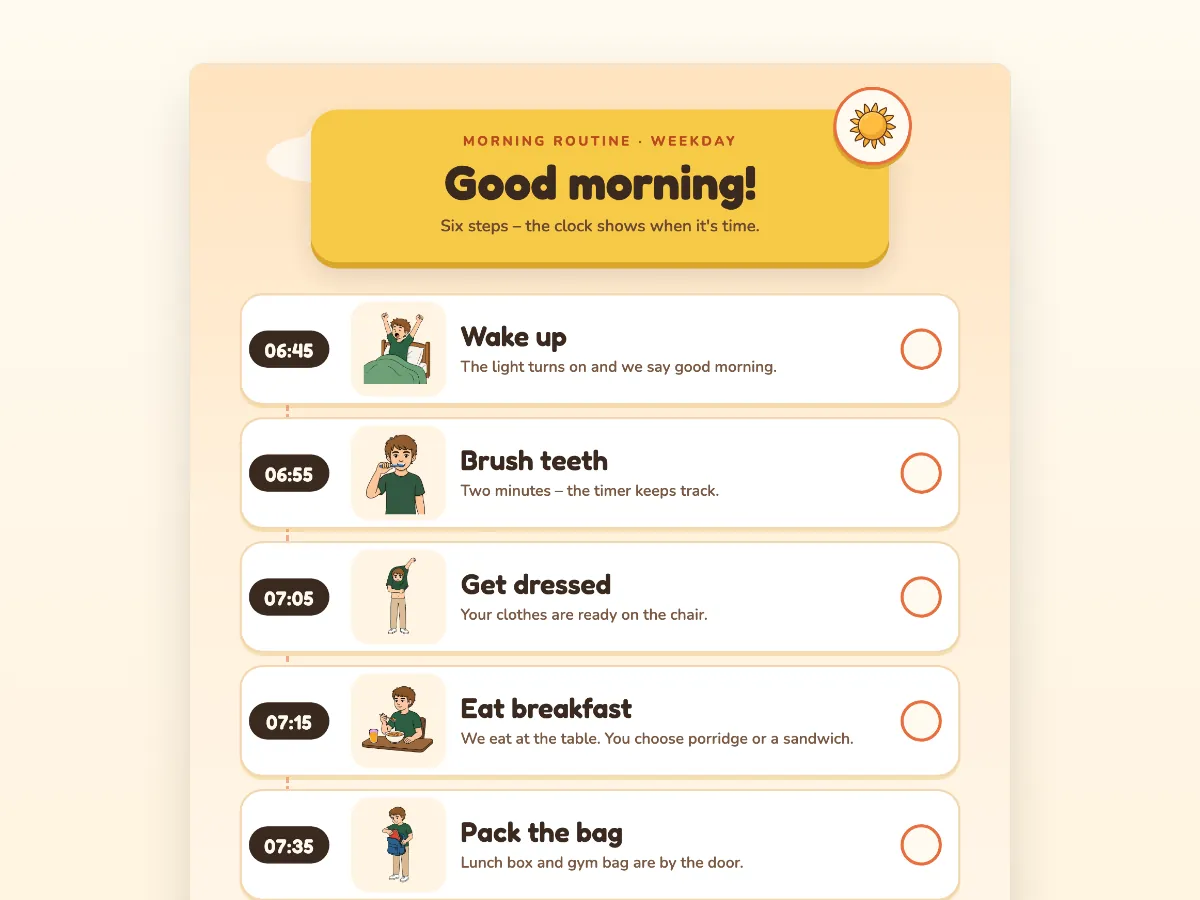
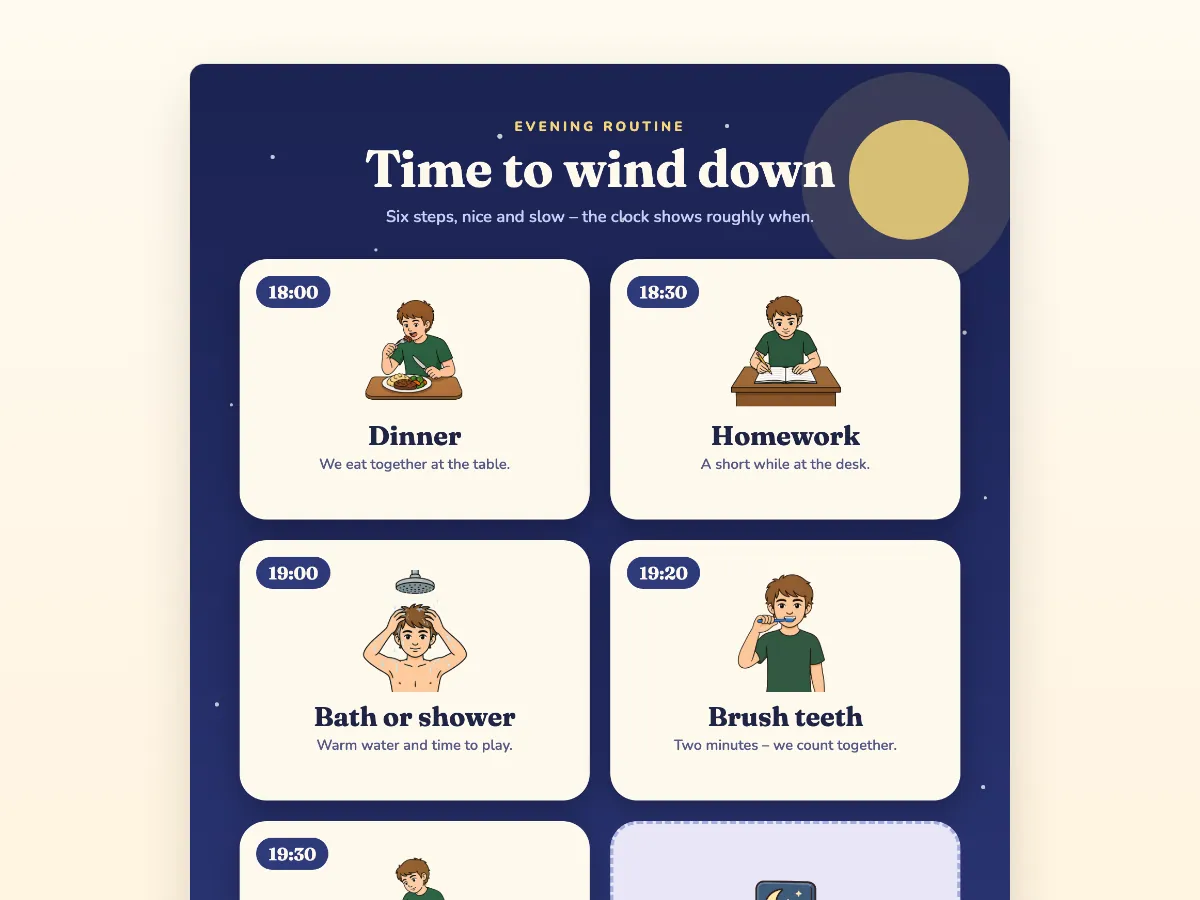
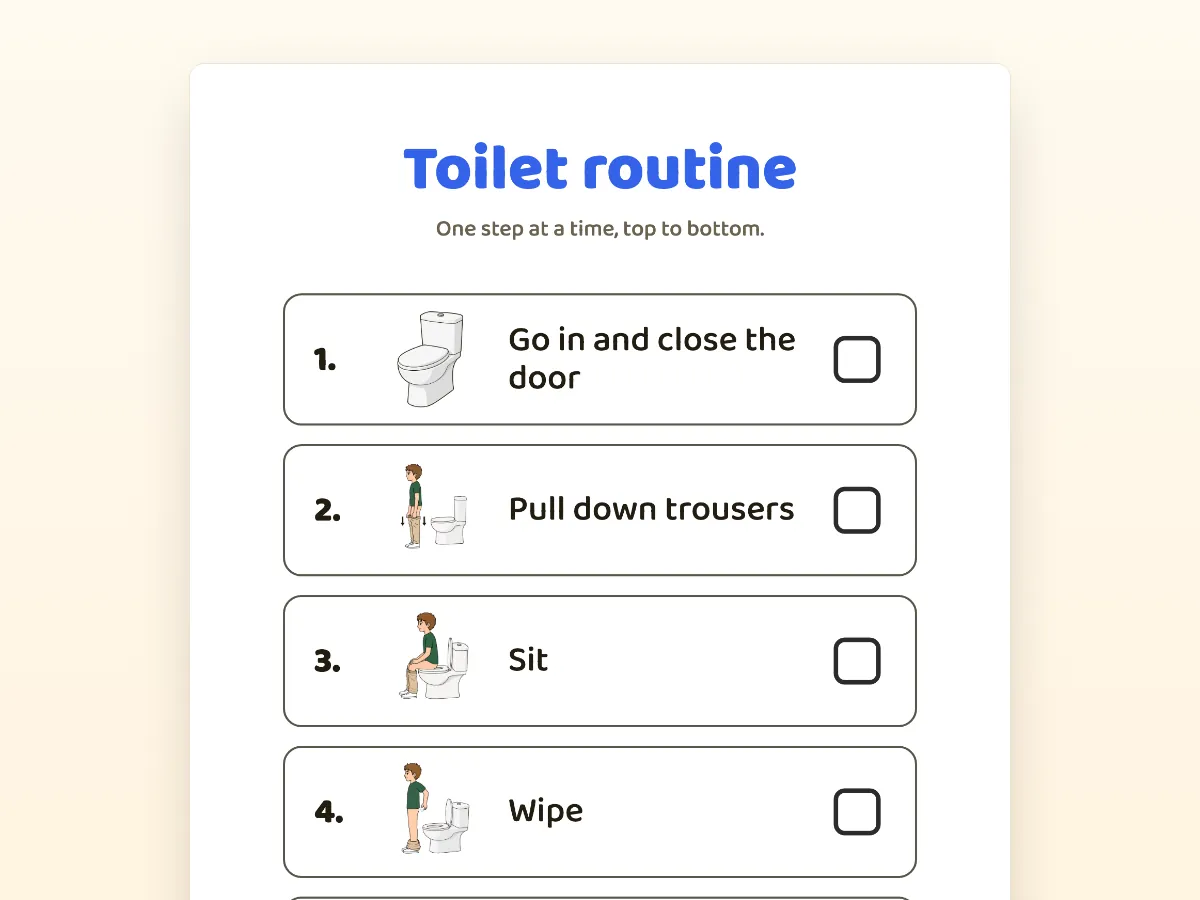
The Áigi templates to start from:
- Morning routine: six steps from waking up to going to school, with times.
- Evening routine: dinner, homework, bath or shower, brush teeth, read a book and lights out.
- Toilet routine: six numbered steps, from closing the door to washing hands.
- School day: circle time, Swedish, break, maths, lunch and PE, with times.
- Weekly schedule: one colour and one symbol per day, from Monday to the weekend.
- Leisure activities: a choice board with activities and words like yes, no and help.
The school day works in preschool too: swap the steps for your day.
Make the template your own before you print
A template is a start, not an answer key. A visual schedule for a child works better the closer it is to how the morning actually goes in your home.
- The steps. Click a text and retype it. Remove what you don’t do and add what is missing.
- The order. Drag a step to a new place if breakfast comes before getting dressed.
- The times. Change the times, or remove them if the child does not use the clock.
- The symbols. Swap a symbol by searching, browsing or picking one of your own.
- Your own photos. Upload a photo of the child’s own backpack or the bathroom and use it directly in the card.
Choose pictures the child understands
Not all children understand the same kind of picture. SPSM, the Swedish National Agency for Special Needs Education and Schools, advises starting from the child’s ability to understand abstraction: begin with concrete objects, then add photos, drawn pictures and possibly text (SPSM, 2026).
In practice, symbols often work well for actions like “brush teeth” or “eat breakfast”, which look the same for everyone. For specific places and things, like your own bathroom or the schoolyard, a photo can be clearer. More about symbols and photos on the symbols page.
How to print the visual schedule so it lasts
- Save as a PDF. Then the paper prints on A4 the way you see it on screen.
- Laminate it. Or put the paper in a plastic sleeve. Then it survives water in the bathroom and fingers at the breakfast table.
- Put it up where the routine happens. The toilet routine in the bathroom, the morning routine in the hall or by the breakfast table.
- Put it at the child’s height. The child should be able to see and point to the next step.
- One visual schedule per place. Several papers on the same wall easily become a wall of paper.
- Keep the file. When something changes, you print a new one instead of starting over.
Make the visual schedule work in everyday life
A paper on the wall does not do the job by itself. Go through the steps with the child the first few times. Point to the next step instead of saying it. A systematic review found that visual activity schedules can be considered evidence-based practice in autism, especially together with systematic instruction (Knight, Sartini & Spriggs, 2015). In practice, that means someone teaches the child to use the schedule.
Give it time. SPSM writes that it can be important to keep the support even when it sometimes looks as if the child is not using it (SPSM, 2026). And change it when everyday life changes: a visual schedule that is no longer right is one people stop trusting.
Want to know more about why visual supports help? Read what visual supports are and how they work in practice.
When paper is not enough
Printed visual supports suit fixed routines that look the same every day. For what changes from day to day, Áigi Standard and Pro have Screen: the visual support sits on the child’s tablet as a link that stays, and you change what it shows and when. The other adults, at home or at school, can get a link to the paper. And if you would rather not start from a template, you can describe what you need and let the AI build the draft, as we write about in AI visual supports. Everything about the tool is on the web app page.
Common questions
Are the visual schedules really free?
Yes. The free version of Áigi Plan includes the symbol library, the templates and printing as a PDF or an image. There is a limit on how many papers you can save; it is on the Pricing page. Bildstöd.se is a free resource.
Can I print visual supports for preschool?
Yes, in the same way. Start from the school day template and swap the steps for the preschool day, for example circle time, play, meals and rest.
What format should I print in?
Save the paper as a PDF, and it prints on A4. Laminate it if it will hang somewhere wet or be handled often.
Can I use my own photos in the visual schedule?
Yes. Upload a photo and use it directly in a card, next to the library’s symbols.
Sources
Most sources are in Swedish; the research article is in English.
- SPSM (2026). Visuellt stöd i förskolan (Studiepaket NPF, Tydliggörande pedagogik i förskolan). Published 2026-02-17. spsm.se
- Knight, V., Sartini, E. & Spriggs, A. D. (2015). Evaluating visual activity schedules as evidence-based practice for individuals with autism spectrum disorders. Journal of Autism and Developmental Disorders, 45(1), 157–178. PubMed
- Bildstöd.se (2026). Välkommen till Bildstöd.se (start page). Read 2026-09-29. bildstod.vgregion.se
- Västra Götalandsregionen (2026). Dart: Gör egna bildstöd. Read 2026-09-29. vgregion.se