This article looks at what autism means, why visual support in particular helps, and which concrete kinds of visual supports are used in everyday life. The foundation is structured teaching, and we are clear about what research does and does not say.
What autism is
Autism is a neurodevelopmental condition that you are born with (1177, 2026). Under the DSM-5 diagnostic manual, it is described in two areas: differences in social interaction and communication, and repetitive behaviour, strong interests and a need for routines. It often also comes with different sensory reactivity, where sound, light or touch can feel stronger or weaker than for others (Autismforum).
Autism is a spectrum. Support needs and strengths look different from person to person. Many autistic people, for example, are good at noticing details and patterns, staying focused on what engages them, and meeting the world in a direct and honest way.
Why visual support in particular helps
This is where autism differs from, for example, ADHD, where support is mostly about taking load off working memory and time. With autism, there are two clear reasons to work visually.
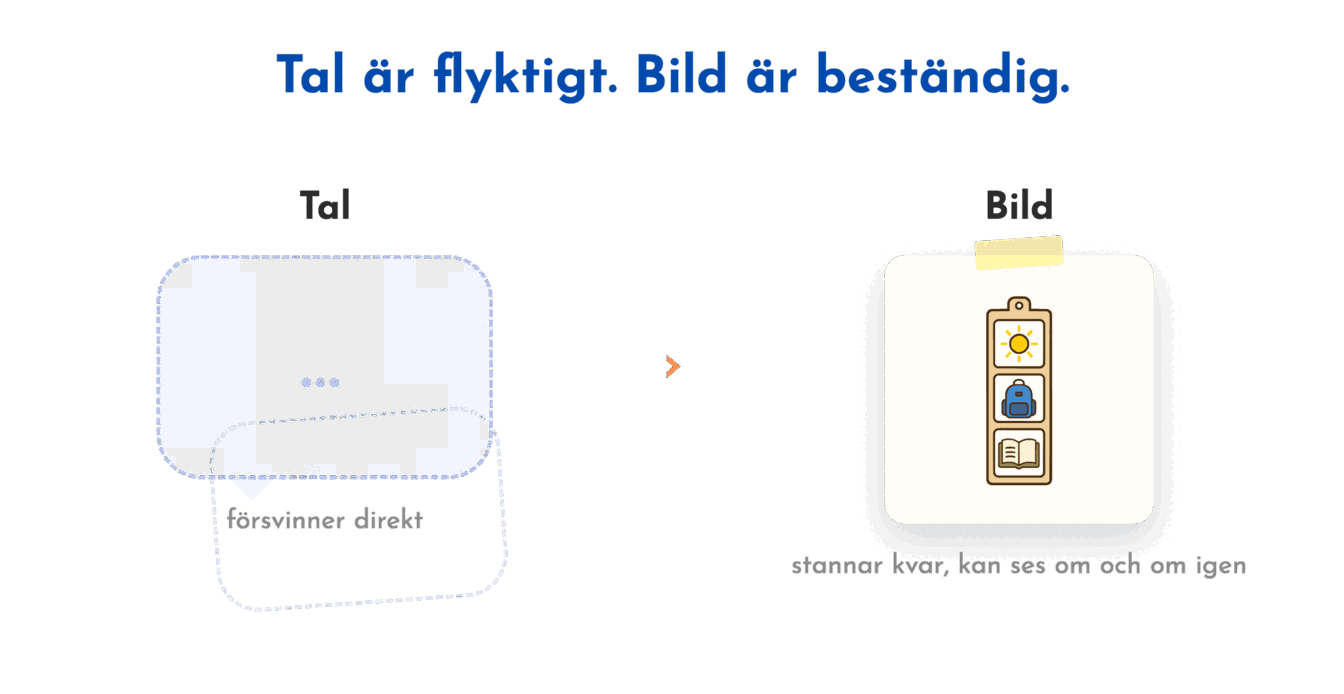
A picture lasts; speech is fleeting. Spoken information passes quickly and requires you to take it in, interpret it and remember it in the moment. A picture stays and can be processed at your own pace, again and again. SPSM, the Swedish National Agency for Special Needs Education and Schools, writes that autistic people often find it easier to take in visual information than auditory information (SPSM, 2026).
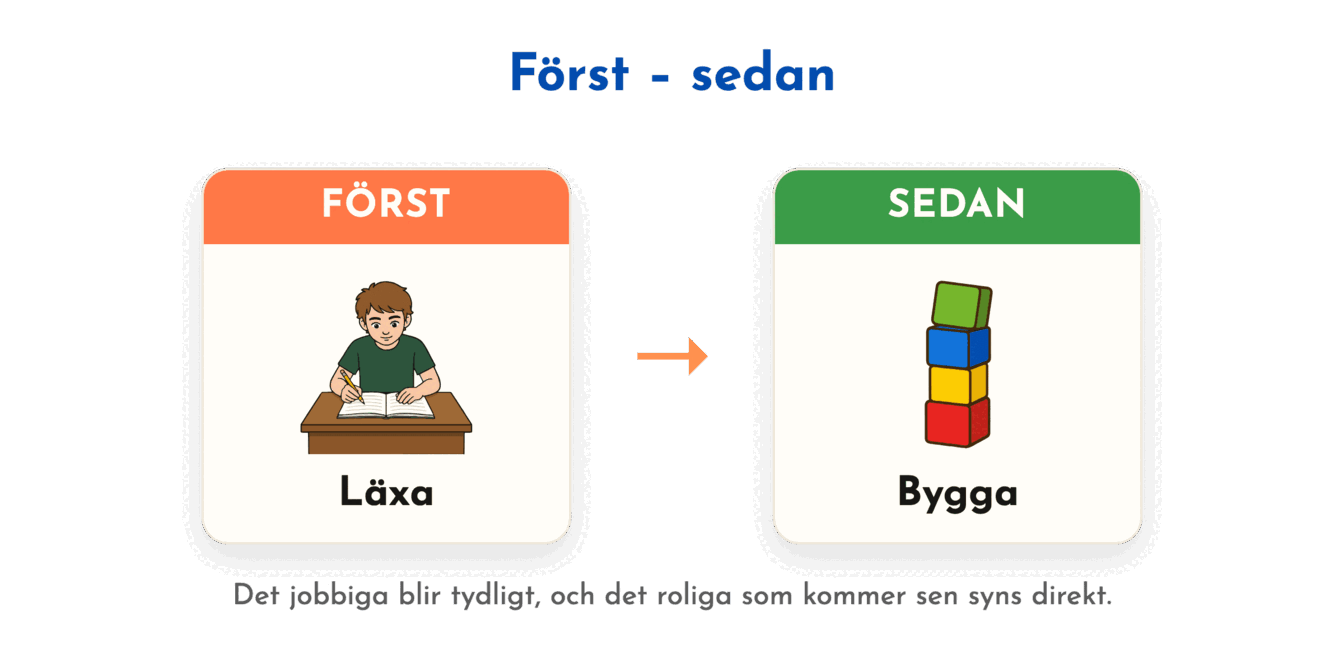
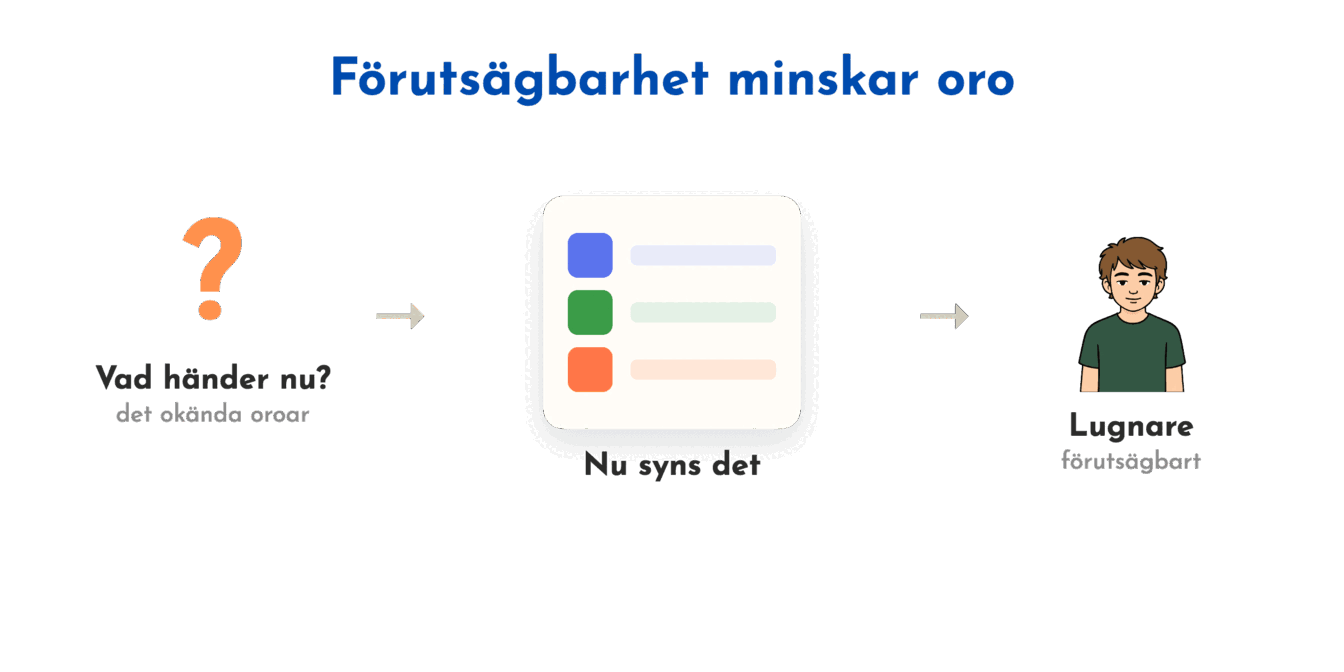
Predictability reduces worry. A recurring feature of autism is a need to know what is going to happen. The unknown can cause stress. When the day, the activity or the transition is made visible, it becomes more predictable, and some of the worry can go away.
Structured teaching and TEACCH
A common approach in Sweden is called tydliggörande pedagogik, structured teaching. It has roots in TEACCH (Treatment and Education of Autistic and related Communication-handicapped Children), a model for structured learning that grew out of the University of North Carolina in the 1970s, built on understanding how autistic people think, communicate and function (Mesibov & Shea, 2010).
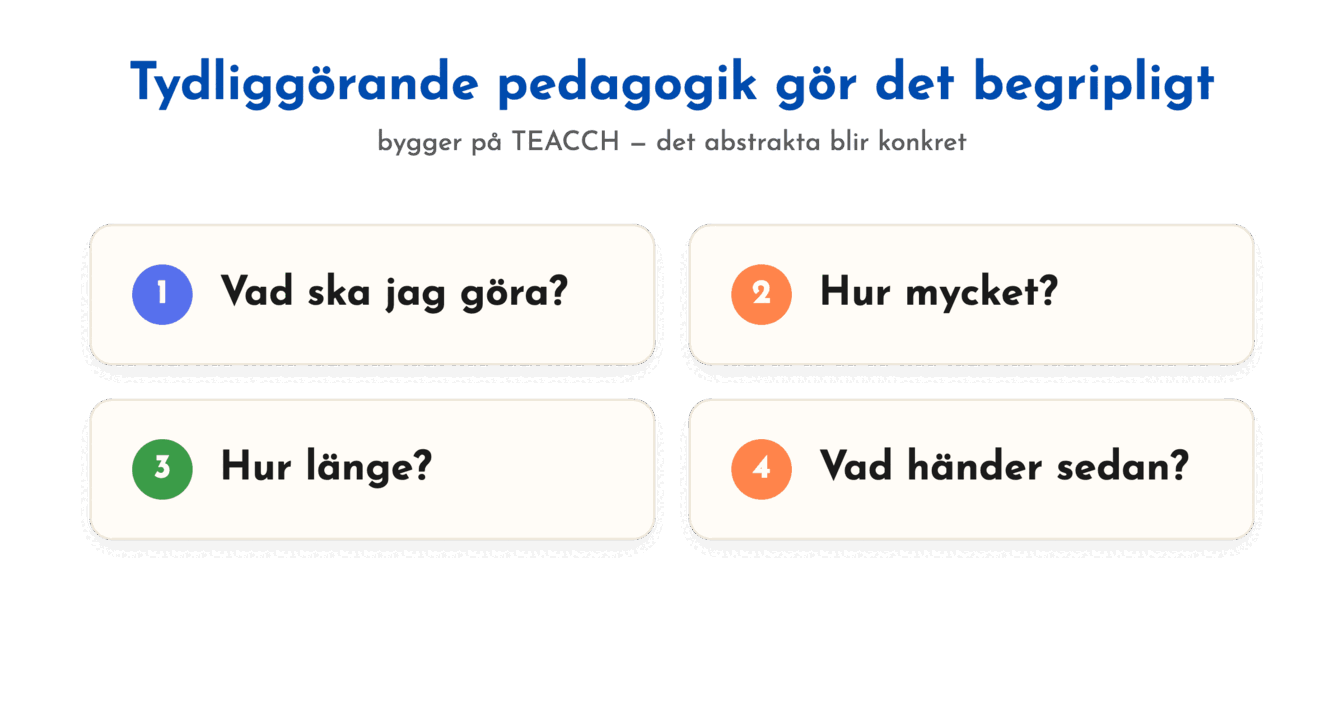
The core idea is to make the abstract concrete. Visual support answers the questions that would otherwise be left hanging. SPSM (2024) describes structured teaching as giving answers to questions like: what am I going to do, where should I be, how long should I do it, and what do I do next?
What SPSM and Socialstyrelsen recommend
SPSM highlights visual support as a central adjustment for autism. In its guidance on autism and teaching (2026), it recommends picture schedules for the day, weekly and daily schedules, making time visual, preparing for transitions and changes, and offering AAC (augmentative and alternative communication) in social interaction and to help put feelings into words.
The national guidelines from Socialstyrelsen, Sweden’s National Board of Health and Welfare (2024), recommend that autistic people be offered cognitive support. The Swedish national care and support programme for autism, developed by the regions within the National Programme Area for Mental Health, describes what that can include: a visual overview with pictures and time aids, together with structure, routines and adjustments to the environment.
Visual supports for autism
Some forms of visual support that suit autism particularly well, and what they do:
- Daily schedule: makes the day predictable and shows what happens next
- First–then board: shows that something less fun comes before something to look forward to
- Transition warning: a picture or countdown that prepares for a change of activity
- Social stories: describe a situation in pictures and text, so it makes sense in advance
- AAC and communication board: pictures to point at when speech is not enough
- Clear expectations: what to do, how much, for how long, and what happens next
Several of these are available as templates to start from, for example a school day schedule and a weekly schedule.
Generic or personal visual supports
Not all visual support is the same. Generic symbols work well for actions like “brush teeth” or “eat”. For specific places, people or objects, a generic picture is not always enough. A generic picture of a classroom cannot show your own classroom. That is where visual supports built from your own photos can make recognition easier, which often matters even more with autism, where details count.
The point is not that one replaces the other. Generic support is often exactly right. Personal visual support adds something when the specific matters.
What we know, and what we don’t
The theoretical foundation is strong, and visual support is recommended by both SPSM and Socialstyrelsen. International research reviews count visual supports as an evidence-based practice for autism (Hume et al., 2021), and a systematic review found that visual activity schedules can be considered evidence-based practice, especially when combined with systematic instruction (Knight, Sartini & Spriggs, 2015). At the same time, the Swedish Agency for Health Technology Assessment (SBU, 2025) has listed the effect of cognitive support and aids for adults with ADHD or autism, compared with no such support, as a knowledge gap, because robust comparative research is missing. That does not mean it doesn’t help; it means the evidence is still being built.
So we describe visual supports for what they are: a recommended and well-tried way to make everyday life easier to understand and more predictable. Not a treatment that cures.
Get started
Start small. A daily schedule or a first–then board for a situation that comes up again and again is a good start.
In Áigi Plan you can create your own schedules and visual supports quickly, with symbols from the library or your own photos. Start from a template or try it free at web.aigiplan.com.
Want to read more? See What are visual supports, and how do they work in practice? and ADHD and visual supports.
Sources
Swedish sources are marked (sv); the research articles are in English.
- 1177 (2026). Autism (sv). Last updated 22 September 2026. 1177.se
- Autismforum, Habilitering & Hälsa, Region Stockholm (undated). Diagnoskriterier för autism (DSM-5, sv). autismforum.se
- SPSM (2026). Autism och undervisning (sv). Published 17 August 2026. spsm.se
- SPSM (2024). Tydliggörande pedagogik (sv). Published 11 November 2024. spsm.se
- Mesibov, G. B. & Shea, V. (2010). The TEACCH program in the era of evidence-based practice. Journal of Autism and Developmental Disorders, 40(5), 570–579. PubMed
- Hume, K. et al. (2021). Evidence-based practices for children, youth, and young adults with autism: Third generation review. Journal of Autism and Developmental Disorders, 51(11), 4013–4032. PubMed
- Knight, V., Sartini, E. & Spriggs, A. D. (2015). Evaluating visual activity schedules as evidence-based practice for individuals with autism spectrum disorders. Journal of Autism and Developmental Disorders, 45(1), 157–178. PubMed
- Socialstyrelsen (2024). Nationella riktlinjer för vård och stöd vid adhd och autism (sv). socialstyrelsen.se
- Nationellt programområde psykisk hälsa, Uppdrag Psykisk Hälsa/SKR (2026). Vård- och insatsprogram autism: Kognitivt stöd (sv). Updated 3 June 2026. vardochinsats.se
- SBU (2025). Kognitivt stöd, inklusive hjälpmedel, för vuxna med adhd eller autism, jämfört med inget kognitivt stöd eller hjälpmedel (knowledge gap, sv). sbu.se
- Autism Sverige (undated). Bildstöd (sv). autism.se