This article looks at what ADHD means at the level of everyday functioning, why external structure helps according to one of the most established models of ADHD, and what Swedish authorities and health services recommend. We are also clear about what research cannot yet answer.
ADHD is about self-regulation
ADHD is a neurodevelopmental condition that affects how the brain regulates attention, impulses and activity level. It has nothing to do with intelligence or willpower (1177, 2022).
One of the most influential theoretical models comes from Russell Barkley. According to Barkley (1997), the core of ADHD is impaired behavioural inhibition, the ability to pause before acting. That impaired inhibition in turn affects four executive functions that build on it: working memory, self-regulation of emotion and motivation, internalised speech (the inner dialogue we use to steer ourselves), and the ability to plan and put actions together.
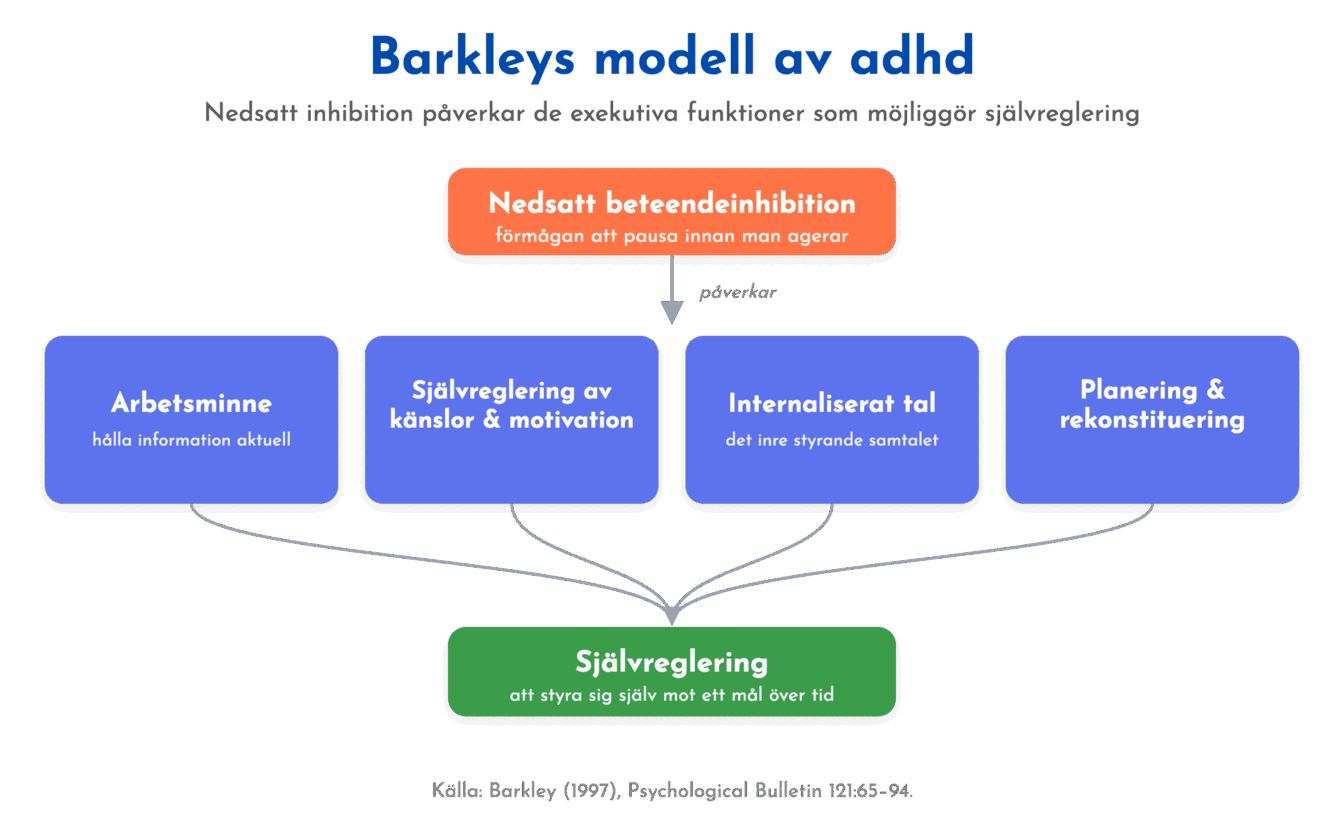
Executive functions are the brain’s system for planning, keeping information active and steering yourself towards a goal. When they are overloaded, it gets harder to get started, to hold several steps in mind at once and to finish what you began.
Functions that are often affected
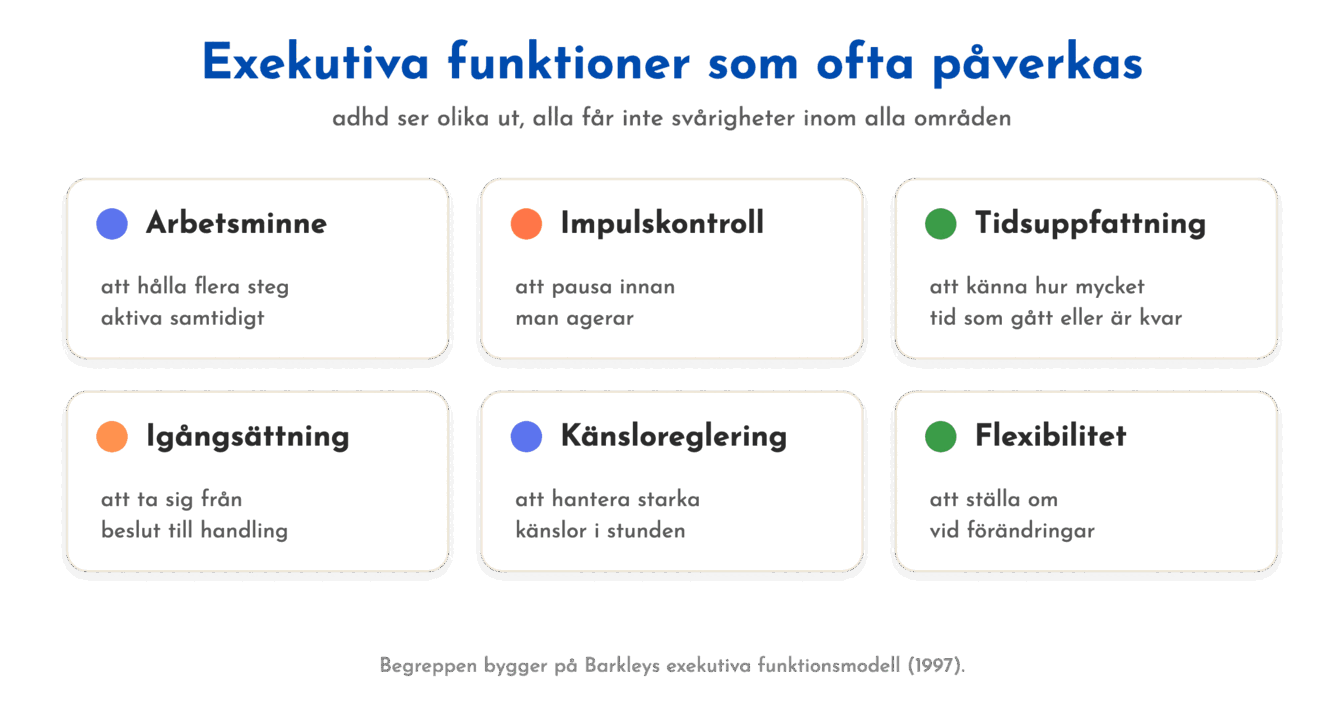
ADHD looks different in different people, and not everyone has difficulties in every area. But several functions come up again and again. Meta-analyses have found, for example, that working memory (Kasper, Alderson & Hudec, 2012) and time perception (Zheng et al., 2022) are affected on average in children with ADHD.
- Working memory: keeping several steps active at once
- Impulse control: pausing before acting
- Sense of time: feeling how much time has passed or is left
- Getting started: moving from decision to action
- Emotion regulation: handling strong feelings in the moment
- Flexibility: adjusting when things change
Why external structure helps
This is where Barkley’s model becomes concrete. In a factsheet on executive functioning, he describes ADHD as a disorder of performance rather than a lack of knowledge. The person often knows what to do, but finds it hard to turn that into action at the right moment. Barkley calls that moment “the point of performance”: the place and time where things actually break down.
The conclusion is that support should be right there. Barkley recommends externalising the functions, moving them out into the environment: making time visible, breaking tasks into small steps, and putting reminders and rules in physical form, in the situation itself.
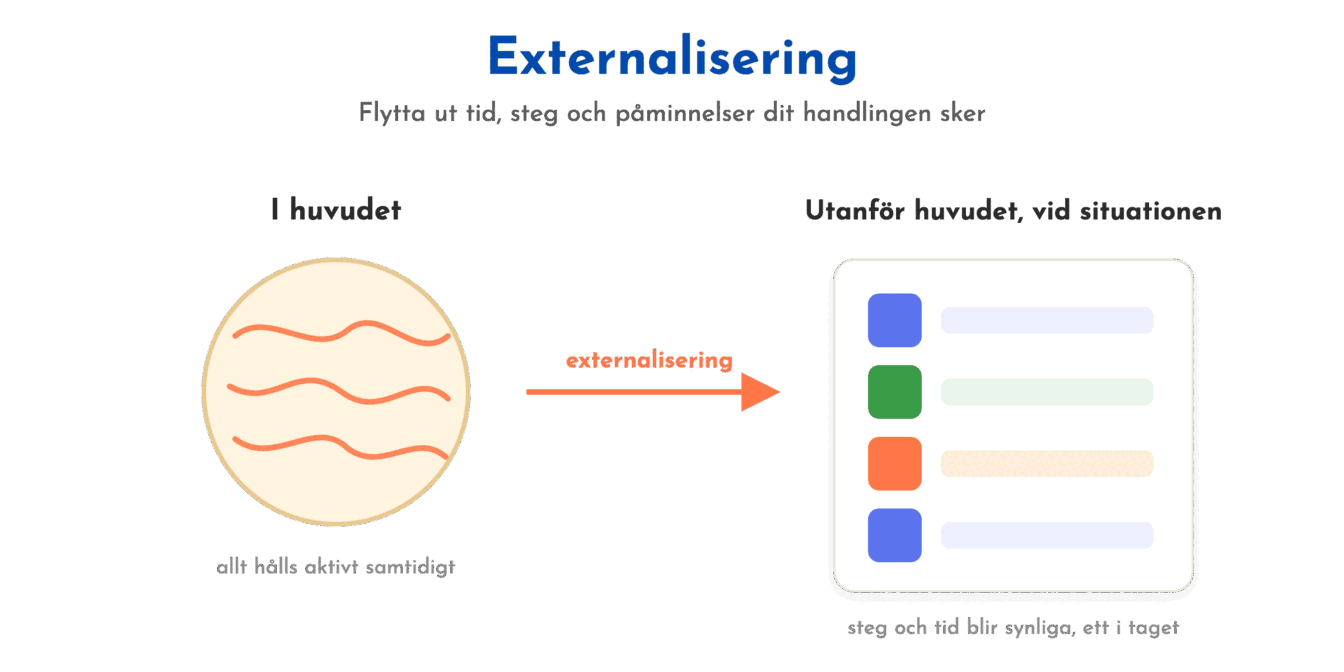
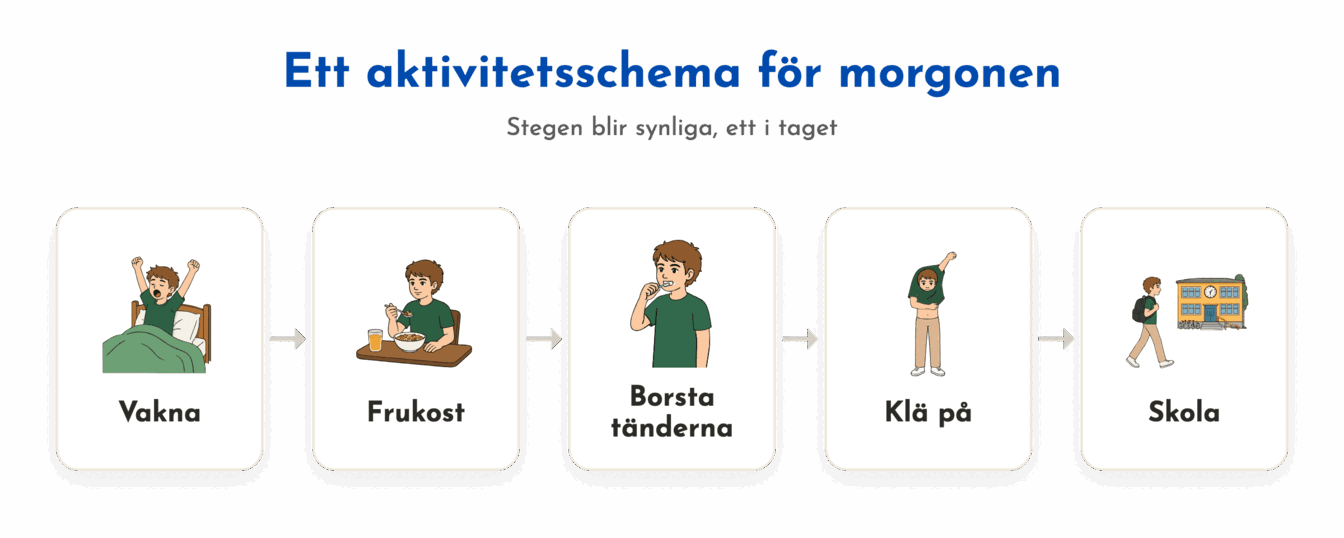
A visual support is a concrete form of that externalisation. A visual schedule moves the steps from working memory onto the wall. Your head no longer has to hold everything, and more capacity is left for actually doing the task.
What SPSM and Swedish health services recommend
Swedish recommendations point the same way.
SPSM, the Swedish National Agency for Special Needs Education and Schools, writes in its guidance on ADHD and teaching that working with visual support “can take load off working memory and promote attention”, and one of its tips is to offer a schedule in the form of visual support (SPSM, 2026). According to SPSM, visual support can be pictures, photographs, symbols, films or physical objects, and it is part of what they call structured teaching (tydliggörande pedagogik).
The Swedish national care and support programme for ADHD, developed by the regions within the National Programme Area for Mental Health, lists cognitive support as one intervention. It includes time aids, reminder aids, visual supports and apps, together with adjustments to the environment and help to establish routines.
Worth noting: SPSM explicitly links visual support to taking load off working memory. That connects the Swedish recommendation with Barkley’s model.
Visual supports to start with
Some forms of visual support that suit ADHD, and the function each one supports:
- Activity schedule: makes the day’s steps and transitions visible, takes load off working memory
- Step-by-step routine: breaks the morning, homework or bedtime into smaller parts
- Time aids and timers: make abstract time visible
- Communication board: pictures to point at when words are not enough
- Feelings board: support for recognising and naming feelings
Several of these are available as templates to start from, for example a morning routine and an evening routine.
Generic or personal visual supports
Not all visual support is the same. Generic symbols work well for actions like “brush teeth” or “homework”; they look the same whatever the context. For specific places and objects, generic pictures are not always enough. A generic picture of a house cannot tell your home apart from someone else’s. That is where visual supports built from your own photos can make recognition easier.
The point is not that one is better than the other. Generic support is often exactly right. Personal visual support adds something when the context matters.
What we know, and what we don’t
It is worth being honest about the state of the evidence. The theoretical foundation is strong, and both SPSM and the national care programme highlight visual support. At the same time, Sweden’s National Board of Health and Welfare (Socialstyrelsen) judges in its national guidelines for ADHD and autism (2024) that the scientific evidence for cognitive support for adults is insufficient, but that, based on clinical experience, the support increases activity and participation in everyday life. The Swedish Agency for Health Technology Assessment (SBU, 2025) has therefore listed the effect of cognitive support and aids for adults with ADHD or autism, compared with no such support, as a knowledge gap. That does not mean visual supports don’t help; it means robust comparative research is still missing.
So we describe visual supports for what they are: a recommended, theoretically well-founded way to take load off overloaded functions. Not a treatment that cures or reduces symptoms.
Get started
A visual support does not have to be advanced to make the day easier to follow. An activity schedule for the morning is a good start.
In Áigi Plan you can create your own schedules and visual supports quickly, with symbols from the library or your own photos. Start from a template or try it free at web.aigiplan.com.
Want to read more? See What are visual supports, and how do they work in practice? and Autism and visual supports.
Sources
Most sources are in Swedish; the research articles are in English.
- 1177 (2022). Adhd. Last updated 23 May 2022. 1177.se
- Barkley, R. A. (1997). Behavioral inhibition, sustained attention, and executive functions: Constructing a unifying theory of ADHD. Psychological Bulletin, 121(1), 65–94. PubMed
- Barkley, R. A. (undated). The Important Role of Executive Functioning and Self-Regulation in ADHD (factsheet). russellbarkley.org
- Kasper, L. J., Alderson, R. M. & Hudec, K. L. (2012). Moderators of working memory deficits in children with attention-deficit/hyperactivity disorder (ADHD): A meta-analytic review. Clinical Psychology Review, 32(7), 605–617. PubMed
- Zheng, Q. et al. (2022). Time perception deficits in children and adolescents with ADHD: A meta-analysis. Journal of Attention Disorders, 26(2), 267–281. PubMed
- SPSM (2026). Adhd och undervisning. Published 17 August 2026. spsm.se
- SPSM (2026). Visuellt stöd i grundskolan (Studiepaket NPF, Tydliggörande pedagogik). Published 17 February 2026. spsm.se
- Nationellt programområde psykisk hälsa, Uppdrag Psykisk Hälsa/SKR (2026). Vård- och insatsprogram adhd: Kognitivt stöd. Updated 18 June 2026. vardochinsats.se
- Socialstyrelsen (2024). Nationella riktlinjer för vård och stöd vid adhd och autism. socialstyrelsen.se
- SBU (2025). Kognitivt stöd, inklusive hjälpmedel, för vuxna med adhd eller autism, jämfört med inget kognitivt stöd eller hjälpmedel (knowledge gap). sbu.se